
The Varied Bunting - A Story of Conservation
- Mithra Chidambaram

- Apr 12
- 3 min read
Updated: Apr 19
I recently drew a color-pencil drawing of a Varied Bunting songbird for the Art of Conservation Songbird Art Contest. I also wrote an artist statement to go along with it. I won 3rd place in the contest.
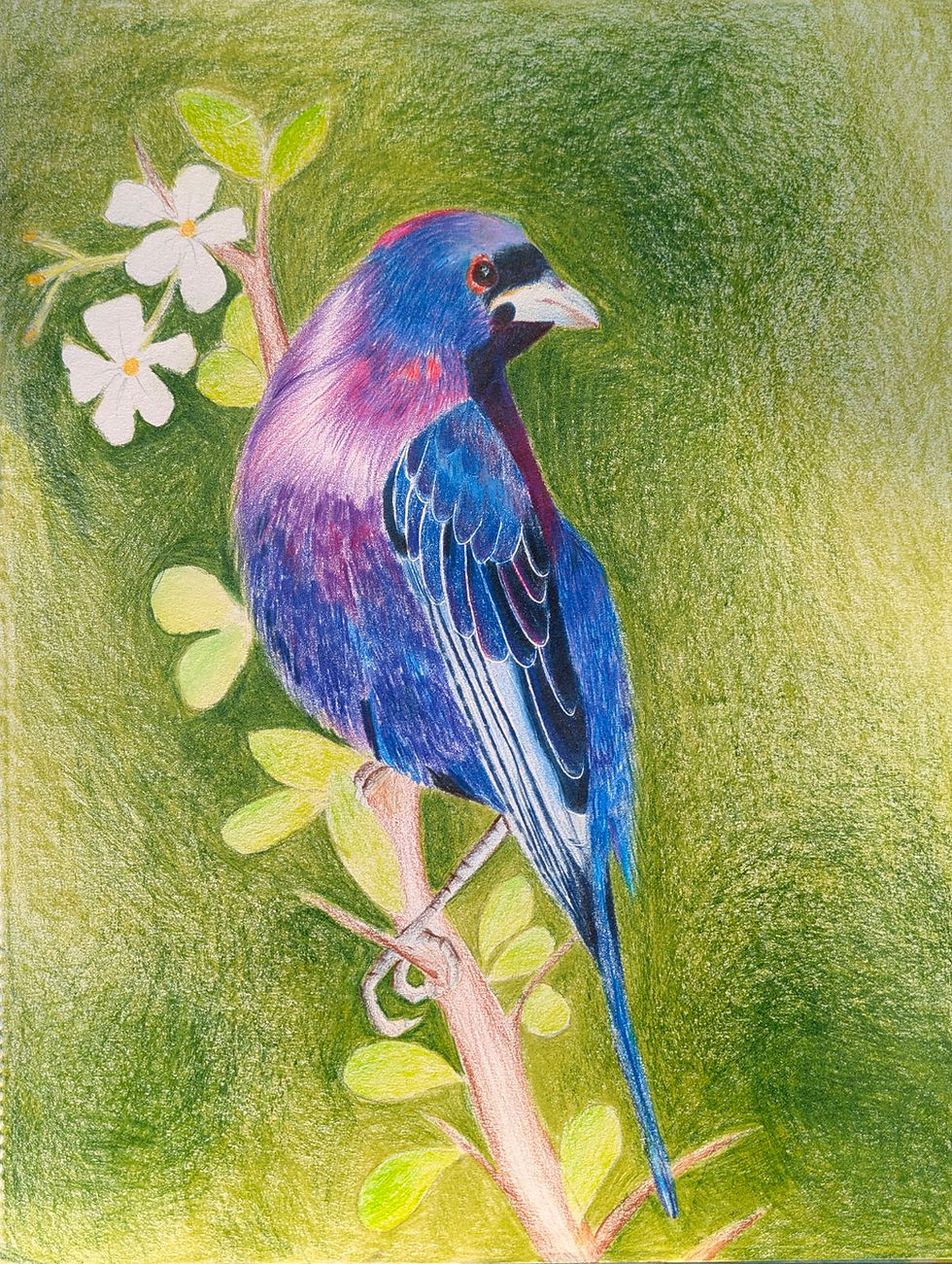
It's the year 2100, 75 years from now...
An 11 year old girl peers through her binoculars. She sights various birds, but one bird stood out - the Varied Bunting Songbird (Passerina versicolor). They are difficult to spot as they have an ability to blend in with the dense shadowed bushes (it’s favorite hiding spot). In broad daylight though, the girl could see a colorful male bird full of magnificent blues, purples and reds. She knew that the Bunting’s features act like mini prisms, so that when the light hits it just right, it scatters the light and makes it look bright and vivid.
It flew to its nest with its vibrant feathers stretched out in its full wingspan of 21 centimeters. Its nest was hidden by a dense thorny bush and inside were 1 blue and 2 green eggs. The girl thought to herself, Having eggs of two colors is rare for a small songbird! She was lucky to spot it, because if the bird was in the shade its feathers would turn dark and that helps it stay safe from predators.
Her thought was broken by the tweet of the Varied Bunting chirping his melodious sweet song. The bird learned his song after he hatched, he started with “babbling” and with practice, he formed his own song. He learned his song by listening to his adult male neighbors. That’s why birds living near each other may have the same song syllables as their neighbors. This is called a “song neighborhood.”
The girl brought down the binoculars from her eyes and said to her 86 year-old grandma, ”These birds are so pretty, Grandma! Especially the Varied Bunting!”
Grandma asked her, “Do you know how there are so many Varied Buntings today?”
“No,” the little girl said.
Grandma told her, “Then let me tell you. When I was a child, there weren’t nearly as many Buntings around. In Texas and Mexico, the dense, thorny scrub where the Bunting lived was being cleared for farms, houses, and mining. Because of this, the Buntings lost their homes and nests. The price of beauty (illegal trade) was also a danger. People illegally captured adult male Buntings, and sold them as pets in the illegal cage bird trade. This made it harder for this species to live in the wild. If these birds became extinct, the bird's jobs—eating bugs and spreading seeds—would stop. When they disappear, the food web gets broken. To make sure the Varied Bunting didn’t go extinct, people protected its home, fought the illegal trade, and students became Citizen Scientists (meaning they reported bird sightings so that researchers knew where to focus their protection efforts.) Even I was a Student Citizen.”
“Wow,” said the girl. She smiled at her grandma. “I’m glad people decided to save the birds!”
Grandma continued, “I personally felt that the Varied Bunting must practice and learn to find its voice. I also started my journey as an artist by drawing and submitting a picture of the Varied Bunting for a Songbird Conservation Art Contest in 2025. I proudly signed the picture with my full name - Mithra Chidambaram.”
If you liked this blog post, please leave a comment below. See you in the next blog - Mithra



Comments